

It’s been a busy fall with back-to-back in-person and virtual heat meetings, but three stood out to me the most: the Global Heat Forum in Bangkok, a heat workshop at the U.S. National Science Foundation National Center for Atmospheric Research (NSF NCAR) in Boulder, and the Palm Springs Heat Summit, convened by the City of Palm Springs. One line repeated several times in Bangkok has stayed with me longer than anything else I heard: heat is no longer an invisible killer. It has the world’s attention. What it needs now is action.
Almost 700 people from across the world came to Bangkok for the Global Heat Forum. It was amazing to see the once-small heat community grow to this size, with this level of organization, and with researchers, practitioners, advocates, and funders all working together to address extreme heat. The forum was organized by the Global Heat Health Information Network (GHHIN) and the World Meteorological Organization (WMO), with support from the Asian Development Bank, Bangkok Climate Action Week, ClimateWorks Foundation, the Children’s Investment Fund Foundation, the Climate & Health Funders Coalition, The Rockefeller Foundation, and Wellcome. I’m grateful to the funders who made it possible, and for their engagement throughout the week.
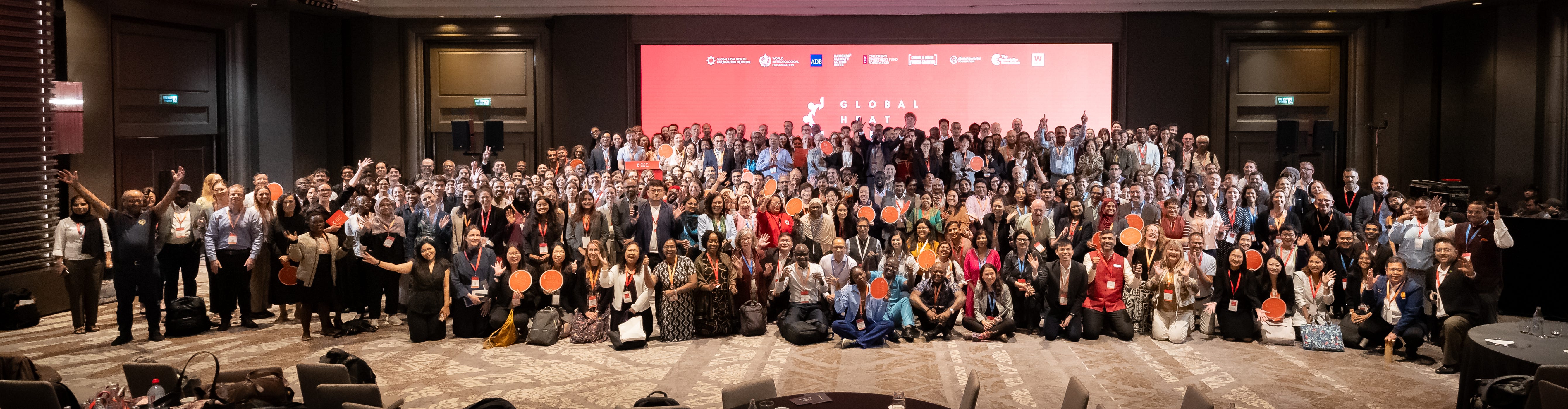
Making heat more “visible” hasn't been fast, and it hasn't been easy. Turning that visibility into action, especially action that looks beyond a single summer’s record-breaking heat, is our next challenge. Three things from these meetings have helped shape how I’m thinking about that now.
Heat health has worked. Let’s take it further.
The heat health community has made heat more visible. Framing extreme heat as a health issue gave it a problem owner, early warning systems, heat action plans, and a home in agencies like the WMO and the World Health Organization. The heat health framing is a major reason 700 people were in Bangkok.
The next step is to carry that success from health into other sectors that shape heat over decades. So far, most of what the health framing has built is heat management: efforts to plan for, prepare for, and respond to heat that cannot be mitigated. Public health, emergency management, and disaster response do this work well, and much of their heat work focuses on the season and the event. The longer-term work includes housing, energy, transportation, land use, and buildings. Much of it is heat mitigation: efforts to reduce the built environment’s contribution to urban heat, largely the work of urban planners and designers. Some of it is also long-term heat management, for example, keeping indoor cooling reliable on the energy grids we’ll have in 2036.
During our keynote at the start of the forum, where we presented the findings from the Global Scientific Synthesis Report on Extreme Heat and Health, I asked the room who was working on heat efforts with a long-term horizon. From my vantage on the stage, only about a dozen hands went up out of almost 700, fewer than 2 in every 100 people at the world's largest heat meeting. That’s just my informal count, but afterward several of them told me they felt underrepresented in the heat community.
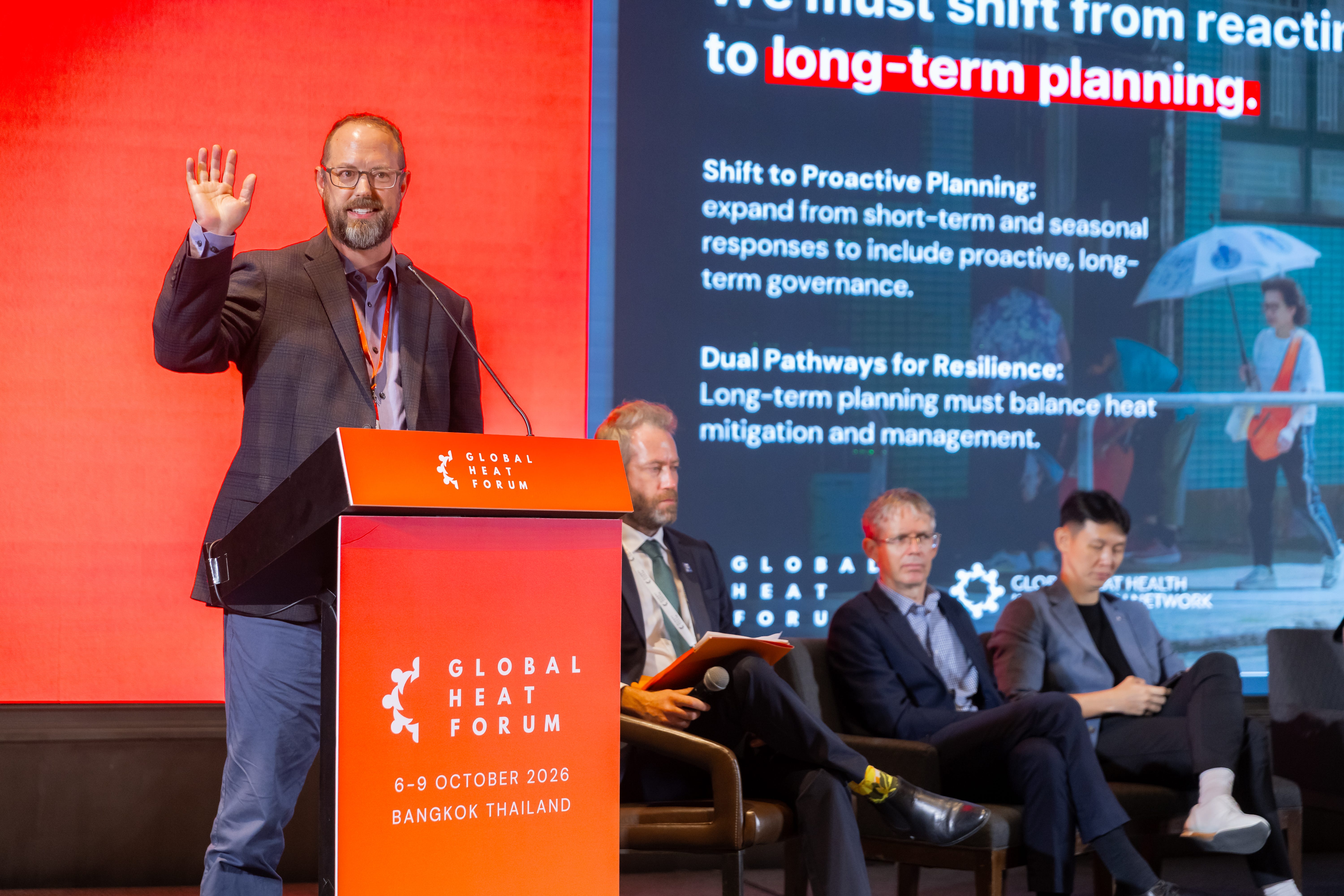
Long-term heat planning and governance compete for the same limited staff, budgets, and political attention as short-term heat preparation and response, and their benefits often arrive after the officials who fund them have left office. That’s why long-term heat governance needs what the heat health framing gave heat management: a problem owner.
Heat crosses every line we draw.
We naturally organize our response to heat by boundaries: city limits, agency mandates, and hazard types. Heat crosses all of them.
Palm Springs is a small but well-known city, and the same heat that has historically driven its success is now threatening it. I spoke at their heat summit, which drew practitioners and community members from across the region. A $400,000 state grant is funding Palm Springs's development of a shade and heat mitigation plan to improve shading at bus stops, parks, and bike lanes. Many summit participants were excited about the shade plan but noted that their personal heat exposure doesn’t end at the city limits. Many people who work in Palm Springs live in smaller, more affordable communities outside it, with heat risk present at home and on the commute. Like most regions in the United States, those smaller communities don’t yet have their own heat plan. The city’s shade plan is a great start, but we also need to address heat across a region's entire heatshed.
Bangkok showed the other kind of boundary. While the heat forum was underway, Thailand was recovering from catastrophic floods that killed at least 60 people and affected more than 3 million. At the same time, smoke from forest and land fires in Indonesia was spreading across the region, closing schools from Malaysia to Timor-Leste. Palm Springs shows why heat planning can’t stop at a city’s border. Bangkok shows why it can’t stop at a single hazard's border either.
We don’t have all the evidence. We must act anyway.
One question I heard across all three meetings, including from the city and county practitioners at the NSF NCAR workshop, is what some call the $100,000 question: if you had $100,000 to spend on heat in your city, how would you spend it? We don’t have a good answer yet. We have a full suite of heat strategies, from cooling centers and early warning systems to shade, trees, and cool roofs, and very little evidence on which delivers the most protection per dollar, and where.
The lack of evaluation isn’t a problem specific to heat, but because heat has historically been underfunded compared to other hazards, the lack of evidence makes it harder to close the funding gap. As I wrote in the Heat Action Plan Implementation and Evaluation (HAPIE) Tool post, cities have, at most, tracked whether they carried out heat actions, not whether outcomes improved, such as whether heat deaths fell or temperatures dropped. Don’t wait for a definitive study to act on heat, though. We need to simultaneously pursue more heat action while also intentionally measuring the outcomes of what we do to better answer the $100,000 question.
What comes next
The Global Heat Forum's funders have already shown they support heat action. My ask is that the next round of support address the three things the heat field lacks most right now: capacity for long-term heat planning and governance, coordination across jurisdictions and hazards, and evaluation of the outcomes of the heat actions we already fund.
For everyone else, ask yourself: who in your community is responsible for addressing heat beyond the next five years? If the answer is no one, tell me in the comments.
— Ladd
One of the things I find most challenging about evaluation is something you mention further up in the post -- it's the same people doing the work. Their time, energy, and funding are all finite resources, and spending them on evaluation doesn't seem as urgent as spending them elsewhere. It would be helpful if there were funding mechanisms specifically for evaluation.